Showing posts with label CAD. Show all posts

Thursday, October 30, 2014

Musket V-Twin Royal Enfield, Check Out the Latest News

Musket V-Twin, Royal Enfield Based Special
See the latest news regarding the Musket V-Twin here. The ORDER page is up now!

The Musket is a Royal Enfield special created by industrial engineer Aniket Vardhan. He designed and made casting patterns for a custom bottom end that used two stock Royal Enfield top ends, either 350cc or 500cc, to make a V-twin engine. It's a beautiful piece of work and is meeting with success in the marketplace.


Saturday, December 29, 2012

Stratasys Mojo 3D Printer Leases for $185/month

Stratasys Mojo 3D Printer Kit
Stratasys still has its Mojo 3D printer lease program going here in the US. This is an industrial grade, professional printer of the Fused Deposition Modeling (FDM) type that you can lease for as little as $185/month. It prints with the Stratasys ABSplus material.

You can find a YouTube video of the Mojo in action here at a post we did about it earlier this year.

You can get a free printed sample by registering with Stratasys here.

Please note again that the lease program is available only in the United States.


Friday, September 21, 2012

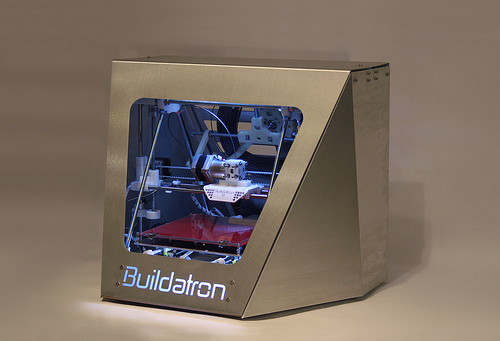
Buildatron 2 3D Printer from Buildatron Systems

Buildatron 2 3D Printer
Buildatron Systems in New York City designs and builds open source 3D printers. The basic design is apparently adapted from the RepRap printer, but is much more robust.

I believe the price for a fully assembled system is $2500, and a DIY unassembled kit is $1599. However, I went to the Buildatron online store page and could not see how to put a unit on order online. A contact number and email address is given there, so if you are interested in a printer you can give those a try.

Buildatron has several galleries of printer pics and parts pics here. Their blog is here.

If you would like to get into the research and design of 3D printers, Buildatron wants you to know that the company is looking for engineers and interns. You can contact the research and design department here.

I have embedded one of their YouTube videos here.


Sunday, August 19, 2012

KScan3D Software Turns Kinect into 3D Color Scanner

KScan3D Human Model
The KScan3D software package from 3D3 Solutions lets you redeploy your Kinect for Windows or Kinect for Xbox 360 as a 3D color scanner. The 3D3 people claim that their software can seamlessly stitch together shots taken from multiple angles to capture a complete 360degree model of an object or person.   The software creatures a 3D mesh model that is automatically combined and aligned. The package also incorporates editing features for smoothing and editing the data.

The resulting model is available for output in four industry-standard file formats: .stl, .obj, .ply and .asc. The model can be used for CAD/CAM work, game design, visual effects, and 3D printing.

The package price is $299... You have to sign-up for an account with 3D3 Solutions to get pricing, by the way, providing your email address and street address, so I did that to save you the hassle. You can purchase  with a credit card or PayPal and download the software immediately.

If you own a Kinect, you can download and test drive KScan3D by taking advantage of the free fourteen-day trial.

You can see a gallery of scans here, and can download them in .ply, .obj, and .stl for examination in your CAD viewer.

If you give KScan3D a try, or are already a user, we'd like to hear what you think of the package... by all means, please leave your comments here at this post.

Wednesday, August 1, 2012

Solidoodle 3D Printer Breaks $500 Price Barrier

Solidoodle 3D Printer
MakerBot's former COO, Samuel Cervantes, left the company last year to launch another 3D printer company, Solidoodle. At $499, the Solidoodle 2 printer breaks the $500 barrier.

The build material is ABS in filament form, available from the Solidoodle store in natural, red, green, blue, and black. The build volume is 6"x6"x6".

Unlike some other small, low-cost 3D printers, the Solidoodle is strong and robust; the Solidoodle people claim that a 200lb. person can stand on the chassis without damaging it, even while it is printing.

See the Solidoodle in action below.


Wednesday, June 20, 2012

Mojo 3D Professional Printer from Stratasys, Under $10K

Mojo 3D Printer Pack from Stratasys
Stratasys has released their new Mojo 3D Fused Deposition Modeling (FDM) printer, and they are promoting it heavily. With this model at $9,900, Stratasys has pushed the price point for professional 3D printers below the $10K barrier.

The build volume of this desktop unit is 5x5x5 inches. The build material is a form of ABS that Stratasys calls ABSplus. Stratasys claims it is very tough and durable. It can be drilled and painted, or even plated.

A leasing program is available in the US for $185/month. I have not been able to find any details about the program on the Web... looks like you've got to contact a sales representative to get that information. Stratasys offers a free sample part for evaluation.

Tuesday, June 12, 2012

B9Creator 3D Printer Kickstarter Completed, Raised Over $500K

The B9Creator Kickstarter funding project we blogged about a few weeks ago is completed. Nearly 400 people committed a combined total of over $513,000, more than ten times the original $50,000 project goal. Amazing, and congratulations to Mike Joyce, creator of this innovative 3D printer.

Tuesday, May 22, 2012

Contes Engineering "Athos" Quad Bike

Contes Engineering "Athos" Quad Bike
We went into downtown Hillsboro the other day for  Saturday Market and saw one of these babies, the Contes Engineering Athos, in the window of the new Hillsboro Bike Company shop that just opened at the corner of Main St. and 2nd Ave. Stepped inside for a closer look and was really impressed with the tech and the apparent quality of the workmanship... four-wheel independent suspension with 8" travel, disk brakes front and back, and Contes Engineering's differential with constant-velocity (CV) drive joints.

The Athos is engineered for street and dirt. 

The Contes website indicates that both their CV joints and differentials will be made available on the market for DIY builders. Contes also offers a consulting engineering service to product developers, with a focus on cycling, though they say they've also done automotive work and automation for semiconductor manufacturing.

Check out the video of the Athos in action below.


Monday, May 14, 2012

B9Creator 3D Printer Fundraising on Kickstarter

A couple of weeks ago we posted a piece about the Bukobot 3D printer Kickstarter fundraiser, which has been quite successful, easily exceeding its maker's fundraising goal of $42K with more than a week left to go. Well, yesterday we found out about another 3D printer project at Kickstarter, the B9Creator fundraiser, which has done amazingly well: In less than a week, and with a month still to go, more than $123,000 has been pledged,  far exceeding owner Michael Joyce's original $50,000 project funding goal.

I think this one is so way-over-the-top successful because of its unique technical approach: Joyce uses a deformable mirror device to project a 1024x768 pixel image onto a layer of light-sensitive resin. The entire layer is immediately cured where the light hits it, so each layer of the printed object is created very rapidly. This is in contrast with Fused Deposition Modeling (FDM) techniques, where the material is laid down in a raster pattern after the fashion of inkjet printing.

Joyce writes that each layer is typically calibrated to be .004" (.1mm) thick, but that the user can trade off speed for even greater resolution. Claimed printing rates are 12-20mm per hour. The resin used is said to be very inexpensive.

The B9Creator is an open source hardware project, so all of the CAD files and software source code files will be made available under an open source license.

On another fun note, check out Michael Joyce's life-sized models of the Lost In Space "Robot B9." (And now you know where the "B9Creator" name came from...)

Update 5/21: With three weeks to go at Kickstarter, pledged funds for the B9Creator total just under $170,000, well over three times the project goal. 

Wednesday, May 2, 2012

Bukobot 3D Printer Kickstarter Funding Drive

Bukobot 3D Printer
The Bukobot 3D printer from Deezmaker is derived from the RepRap open source hardware printer. Deezmaker is attempting to bring the Bukobot to market by raising funds at Kickstarter. The funding goal is to raise $42,000 by May 23; as of this writing, at $19,569 they are just about halfway there, with twenty days to go.

You can follow Bukobot news at their blog.

Update: The committed total is already up over $22,000 less than 24hours later!

Update May 11: The Bukobot is funded! As of this morning, $42,905 with 125 backers and still twelve days to go! 


Monday, April 30, 2012

The UP! Personal, Portable 3D Printer

UP! Personal 3D Printer
Another low-cost, 3D printer for the home, school, lab, and maker/DIY market has come to our attention: the UP! personal and portable printer from Delta Micro Factory Corporation in China. The research we've done so far indicates that the UP! printer has been on the market for about two years now. We have not been able to find a recent review of it, however, there are a number of Youtube videos uploaded by the company and by users.

The American distributor is UP! USA in Brooklyn, NY. Their listed price is $1,499 plus shipping and handling. (You may need to be patient when visiting their website... each page was annoyingly slow to load, at least for us this evening.)

The UP! has its own software environment for setting up the machine and running print jobs. It is claimed that the company is investing significant resources into software development, so that they are releasing frequent software updates that add new features. The software accepts the standard STL file format, so you can use a CAD program of your choice to create models. 

In our researches, we did find that ten UP! printers are being given away as prizes in the Instructables  "Make It Real Challenge" this year (we'll be doing a post about that soon... if you are a maker, take a look, you might want to enter). Meanwhile, check out the UP! demo video below.


Sunday, April 29, 2012

"Making Things Move", an Excellent Book for the Maker

Making Things Move, by Dustyn Roberts
Making Things Move: DIY Mechanisms for the Inventors, Hobbyists, and Artists, by Dustyn Roberts

I found this excellent little book from prominent robotics engineer, consultant, and educator Dustyn Roberts on the new books shelf of our local library this past week. The Robby the Robot themed cover caught my attention right away, but after leafing through it for a few minutes, I found the content compelling and immediately tucked it onto our stack of the day's take-home selections.

This book teaches you how to apply basic mechanical engineering principles, and some basic knowledge of electronics, to your DIY projects without sending you back to school for an engineering degree. Perhaps you are an artist or graphics designer and don't consider yourself a "technical" person, or your technical experience is limited to the more abstract realms of software or chip design, but you'd like to get your hands dirty with a project using mechanical components, such as nuts and bolts, motors, gears, and solenoids. Maybe you have a great idea for a project that incorporates mechanical motion, but you just don't know how to get started. If so, this book can really help and guide you. From the introduction:

In this book, you will learn how to successfully build moving mechanisms through nontechnical explanations, examples, and do-it-yourself projects. Maybe you're a sculptor who wants a piece of art to come alive, a computer scientist who want to explore mechanics, or a product designer who wants to add function to complement the form of  your product. Maybe you've built projects in the past, but they fell apart easily. Or maybe you didn't grow up making things move but want to learn. The students in the class I teach at New York University's Interactive Telecommunications Program in the Tisch School of the Arts have been all of those things, and they gave me the inspiration to write this book. 

Ms. Roberts deliberately goes light on the math throughout... you don't have to be a calculus or physics wiz to understand it, just some knowledge of very basic algebra and trigonometry is all that's required, and if you're rusty on those subjects, you can easily brush up with a little help from the many tutorials available on the Web.

The book begins with a presentation of six basic machines and mechanisms: levers, pulleys, wheels and axles, inclined planes and wedges, screws, and gears. The second chapter presents common project materials (metals, plastics, etc.), their basic properties, and how to choose the right materials for your applications. The third chapter outlines the basics of joining materials with screws, rivets, nails, adhesives, soldering, and so on. The next couple of chapters present some basic physics of mechanics, such as force, torque, friction, energy, work, and power, which lay the background for an understanding of the basic requirements --- strength, power, energy, and so on --- that a successful product will need to meet so that it won't fall apart or otherwise fail.

After these opening chapters concerning fundamentals, the real fun begins, with stepper motors, servos, bearings, bushings, springs, basic electronics, and how to combine them to make simple machines that are useful and fun. The final chapter details a handful of good projects that give you hands-on experience that complements the teachings of the book, such as a miniature wind turbine that powers an LED. Finally, the book closes with an appendix about the popular open source Arduino microcontroller board.

Dustyn Roberts has put together a website and blog for the book. Check it out, the website is very useful. I especially liked the "Resources" page set that is organized around the book's chapter, with videos and links to relevant external resources. Her professional website and blog is also interesting.

As indicated in the quote above, the book is an outgrowth of the author's real classroom experience with real students from diverse academic and professional backgrounds, many with very little or even no hands-on experience of technical work. In this book, she's showing you that you don't have to let this intimidate you and stop you from doing something cool that you really want to do. Study it, work the exercises, apply the principles and you'll get better results from your own DIY projects.


Monday, April 23, 2012

3D Stuffmaker's RepRap 3D Printer

3D Stuffmaker "Allstar" 3D Printer
In response to our recent post about Cubify and the "Cube" 3D printer, one of our readers contacted us about 3D Stuffmaker and their RepRap-derived 3D printers for the DIY market. RepRap is an open-hardware, community-based project, so makers are free to create and market their own printers based on RepRap designs.

The engineers at 3D Stuffmaker have made it their mission t o improve on the RepRap technology, and to make it much more accessible to a wider range of home users and educators by offering DIY kits and assembled printers... at their website, click on the "Sales & Specs" tab to see what's on offer.

If you are in the market for a low-cost 3D printer, or just want to get a feel for what's happening in the 3D print community, check out 3D Stuffmaker.

We will continue to post here about 3D printing and other Rapid Prototyping technologies as things develop in those arenas.

Thursday, April 12, 2012

Cubify 3D Printer for the Home

Cubify 3D Printers
A couple of weeks back we put up a post on the subject of 3D printing, and how it is becoming affordable for home use, moving out of the industrial arena and into the domestic front.  This is a subject we've got a lot of interest in, both personally and professionally, so we are keeping an eye on what's happening in that marketplace.

So, we just found Cube, a new 3D color printer from Cubify. Cube, which starts at $1,299, is targeted at the home market. It features a build volume of 5.5" x 5.5" x 5.5", and can print in ten colors. The plastic printing medium is provided in plastic cassettes that are easily loaded into a slot on the front of the machine.

Cube comes with software that translates users' models into a format that Cube understands. Files are downloaded via its WiFi interface... no cabling required.

Cubify also offers the "Cloud 3D Print" printing service for those who don't want to buy a printer. Pick your material and upload your files, then place your order. Your finished part is then shipped to you.

Stay tuned... We will continue to keep you informed here of other 3D printing products and services as they hit the market. 

Saturday, March 31, 2012

3D Printing Technology for Everyone

Star Trek Replicator Makes Coffee
Remember how the Star Trek crew could order dinner from the console of a wall-mounted "replicator" that would conjure up a four-star meal from the base elements?  Assembled from the ground up from the rawest of raw ingredients: carbon, hydrogen, etc? Today we refer to this kind of device as a "matter assembler," a concept popularized by Eric Drexler in his book, Engines of Creation. (For a really cool fictional treatment of the profound, world-changing impact such capability would have, see one of my all-time favorites, Neal Stephenson's awesome sci-fi novel, The Diamond Age.)

There are a lot of brilliant people working on realizing Drexler's concept of manufacturing essentially anything from the base elements of which it is composed... we call this "molecular assembly" or, more generally,  nanotechnology. Very ambitious, indeed, and probably not something you can do at home... Well then, for the rest of us, there is something a bit more modest but incredibly useful and fun called "3D printing"... and you can do it at home!

MakerBot "Replicator" Low-Cost 3D Printer
The first 3D printers that started coming to market a decade or so ago are very much like inkjet printers, but instead of printing ink on paper, they print three-dimensional objects in layers of extruded or liquid plastics. At first, these printers, from companies like ZCorp, Objet, and Stratasys, were targeted at engineering teams that wanted to quickly build product prototypes to check form, fit, and function (a process known as "rapid prototyping," or RP). The technology was new, so it was expensive ($50,000 or so) and hence out of reach of the home user. That's changing now... affordable printers are on the market now from companies like MakerBot Industries and Bits From Bytes.

The basic concept involves the creation of a 3D model in a computer-aided design (CAD) software system, such as Google SketchUP (which is free!), AutoCAD, or Rhino3D (one of my favorites). The software then translates the completed 3D model into a profile of the device in layered cross-sections... that is, horizontal slices through the model. A 3D printer uses that output file to build up the model in layers that are printed from the bottom-up. You can see this process in action here.

What if you don't want to invest in a MakerBot or RapMan for yourself? Well, now you can use an online 3D printing service, such as the popular Shapeways company. Download yourself a copy of the immensely popular Google SketchUP software, draw a model of the thing you want --- a toy, jewelry piece, whatever --- and upload the output file to Shapeways. Select the material you want it made from --- even metals, such as sterling silver and stainless steel! --- upload the model and get an instant quote on your design, then if you are happy with the price, put it on order.

3D printing is advancing now by leaps and bounds. It is moving beyond prototyping into "digital manufacturing," the creation of one-off, personalized products on demand. For example, you can get eyeglasses on demand from Make Eyewear.

UPDATE: This is incredible... 3D sculptures the size of a grain of sand, created in minutes by a laser printer at the University of Vienna!

Meanwhile, check out the possibilities of nanotech as Neal Stephenson envisions them in The Diamond Age

Sunday, March 18, 2012

core77 Design Blog & Website

Jeff Tiedeken's "Gravity Bike" featured at core77
core77 is a popular, long-running site dedicated to the needs and interests of industrial and graphics designers. If you are an industrial designer or graphics designer, definitely bookmark this site, and check in  on their blog from time to time... lots of useful information there about industry events, design schools, and job openings. Lots of feature articles and blog posts about cool products and concepts from around the world.

A core77 blog post about this very minimalist downhill street bike by California aerospace welder and craftsman, Jeff Tiedeken really caught our eye. It's a coaster in the real sense of the word... no crank and gear set, strictly gravity-powered! While you're at it, check out Jeff's blog about his adventures in design and fabrication, Monkey Likes Shiny.

Update:  We just did another design-related post feature the Derestricted website and blog. Some really great content there.


Saturday, January 7, 2012

Duckman Old Skool CAD Bikes

Mark "Duckman" van der Kwaak is a CAD designer from the Netherlands who creates custom bikes that are simultaneously retro-vintage stylish and high-tech cool. All his work is first modeled and then rendered life-like in 3D CAD. He's an artist, too, with a 50's Lo-Brow style that sometimes recalls Big Daddy Roth. And, man, is he ever prolific... Check out his website and blog at Duckman Old Skool Choppers from Europe where he has thoroughly displayed his work.

Krugger & DBBP Veon, a World Beater at AMD Championship
The main attraction is a huge gallery of his "CADbikes" created in the Pro/E 3D modeling software and rendered in full color. A number of his CADbikes have been built and are on the street today. He just published CADbike #51. Duckman also generously features CADbikes created by his readers.

In addition to bikes, Duckman designs custom bike parts for motorcycle accessories companies around the world. For example this "Rapide" headlight for Crime Scene Choppers. The "Honey Pot Oil Filter" he created for L.A. County Chop Rods is a work of art.

Duckman recently partnered with world champion bike-builder Fred Krugger on the design and construction of the "Veon,", a Harley V-Rod based custom that won the 2010 AMD Custom Bike Building championship.

His website also features extensive galleries of reader's bikes, Harley, British, and Japanese... check it out, I can hardly do him and his work justice here in just a few words.

Tuesday, January 3, 2012

The Musket: A Custom Royal Enfield V-Twin

Aniket Vardhan is this month's DIY hero, without question.

The vintage Royal Enfield Bullet, a classic Brit bike single, went out of production in Jolly Olde England long ago, but is still being manufactured today in Aniket's native India. In fact, there's a network of dealerships in the USA... there's even one right here in Portland, Classic Scooter & Cycle.

Aniket ostensibly came to America in 1999 to earn a degree in Industrial Design (ID)... He did earn that degree, but he says the real truth is, one day in his hometown of Delhi he encountered some guy on a Harley-Davidson, and was captivated by that patented H-D 45-degree V-twin exhaust note. He vowed then and there that he would one day visit their homeland to see them running free in their native wilds.

But in his heart he still cherished a certain significant piece of his native culture: the Royal Enfield Bullet. Only problem is, the Bullet is a single, not a V-twin! Aniket resolved to fix that defect*. He vowed to himself that he would design and build a true V-twin based on the 350cc top end, and plug it into a modified Bullet chassis. He pulled it off through years of patient work and study, hours of flogging the mouse in his Rhino 3D CAD system, and even learning to run a milling machine to create the mold patterns.

You can go to the Musket V-Twin website and get the full story in his own words. It's a great, well-designed site, complete with blog, and an entire section on the process he employed to create and build his first prototype (which really appealed to the engineer in me). Yes, I said "prototype" as he, having gotten a big response from motorcycle enthusiasts from around the world, is going to put engine kits into production for fitment into modified Bullet chassis... and a 1000cc model based on the 500cc Bullet components is forthcoming, also. Meanwhile, check out his video of the bike in action here.

*Just kidding about the single cylinder as defect part... I love thumpers, and my first bike was a Triumph 250cc single, which I miss.

Real Time Analytics